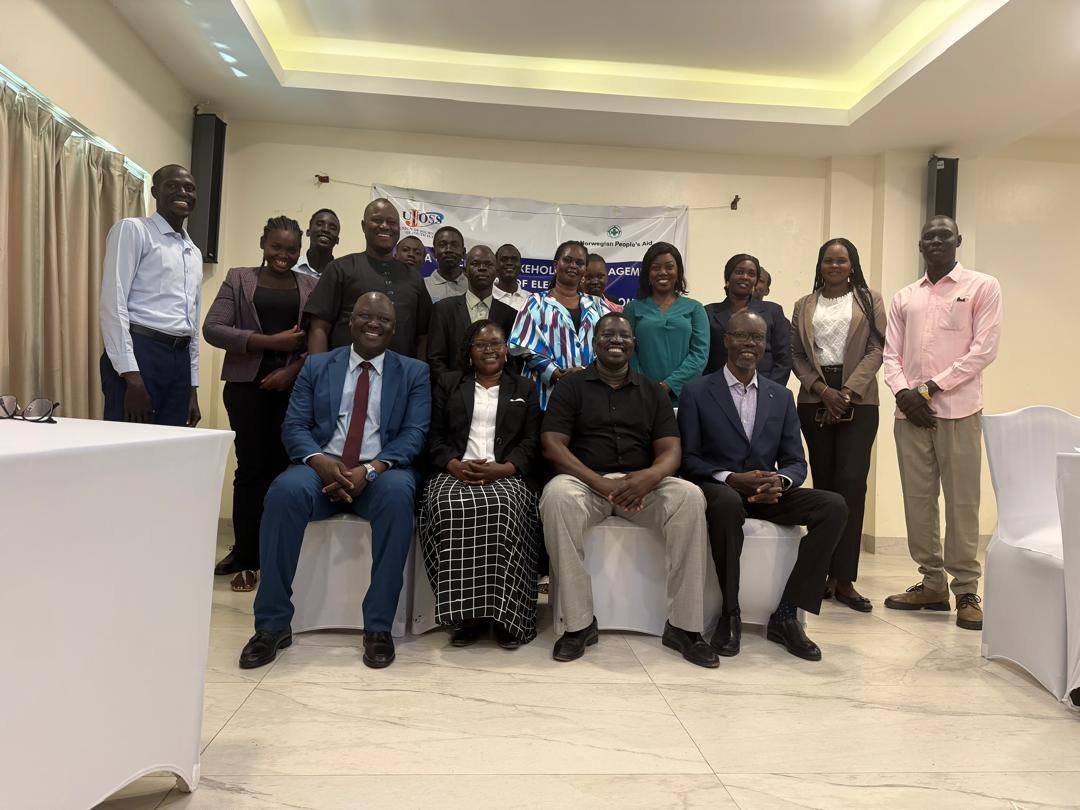

On May 28, 2021, we were officially elected into office, marking the beginning of a profound chapter of responsibility and transformation. I had the immense privilege of taking on the role of President of the Union of Journalists of South Sudan (UJOSS), leading a dedicated National Executive Committee alongside Majak Daniel Kuany Alier as Secretary-General and Yangi Justin as Treasurer.
That election was the first step in a long, rewarding journey that we, as the leadership team, have walked together over the past five years.
From day one, our mission has been anchored in transformational leadership, striving to elevate professional standards, protect our peers, and advocate for an open, secure media environment across our nation.
As we mark this half-decade milestone, our deep appreciation goes to the former leadership team, including Mr. Oliver Modi Philip, Lily Nelson, and the entire UJOSS team that we took over from.
We are profoundly grateful for the foundational bricks they laid, which provided the structural platform enabling us to build, innovate, and drive the progress we celebrate today.
Expanding Our Footprint Across South Sudan
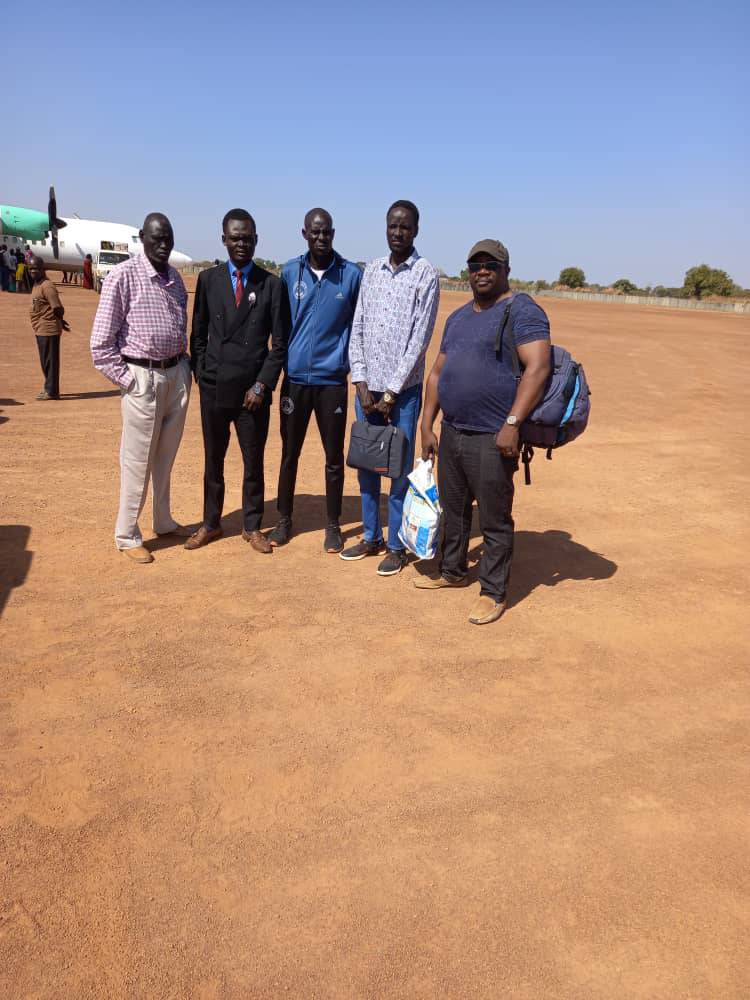
UJOSS Team in Kuajok, Warrap State 2023
Upon our election, the National Executive Committee moved swiftly to establish UJOSS offices in all ten states of South Sudan and the three administrative areas.
This journey took us across the entire length and breadth of the nation, ensuring that our presence was felt far beyond the capital.
We did not stop until we established fully operational bases in every single state capital and administrative center:
- Rumbek – Lakes State
- Torit – Eastern Equatoria State
- Bor – Jonglei State
- Yambio – Western Equatoria State
- Bentiu – Unity State
- Malakal – Upper Nile State
- Wau – Western Bahr el Ghazal State
- Aweil – Northern Bahr el Ghazal State
- Kuajok – Warrap State
- Yei – Central Equatoria State
- The Three Administrative Areas (Ruweng, Pibor, and Abyei)
Once these offices were structurally set up, our focus shifted immediately to institutional capacity building. Over the years, we have systematically equipped every regional office with essential tools, including computers and mobile phones, to ensure our provincial coordinators and teams remain digitally connected, responsive, and functional.
We extend our heartfelt gratitude to UNESCO, Norwegian People’s Aid, Nonviolent Peaceforce, JICA, the European Union, and the Swiss Agency for Development and Cooperation for the invaluable partnership and support they have offered over the years, which has kept our state and administrative offices fully operational.
Capacity Building and Partnerships
We intensified our resource mobilization efforts, partnering with several key international organizations, including UNESCO, Norwegian People’s Aid (NPA), the Swiss Agency for Development and Cooperation, and the European Union, JICA among others. These strategic collaborations made it possible to design and deliver essential training and professional capacity building for our colleagues nationwide.
Today, we can say without fear of contradiction that our team has covered the country. We have visited every state capital and every capital of the three administrative areas, successfully delivering vital professional development opportunities directly to journalists on the ground.
Furthermore, working closely with our partners, we produced and distributed a comprehensive Safety Guide for Journalists in South Sudan, establishing a critical resource that is now readily available across the country.
In our commitment to protective advocacy, we have also continued to actively engage with state authorities to safeguard media practitioners. As part of these efforts, we distributed official press jackets to journalists covering all ten states and three administrative areas this year. While we recognize that the current supply is not enough to meet the total demand, we are actively working with our partners to provide more.
Protecting Press Freedom
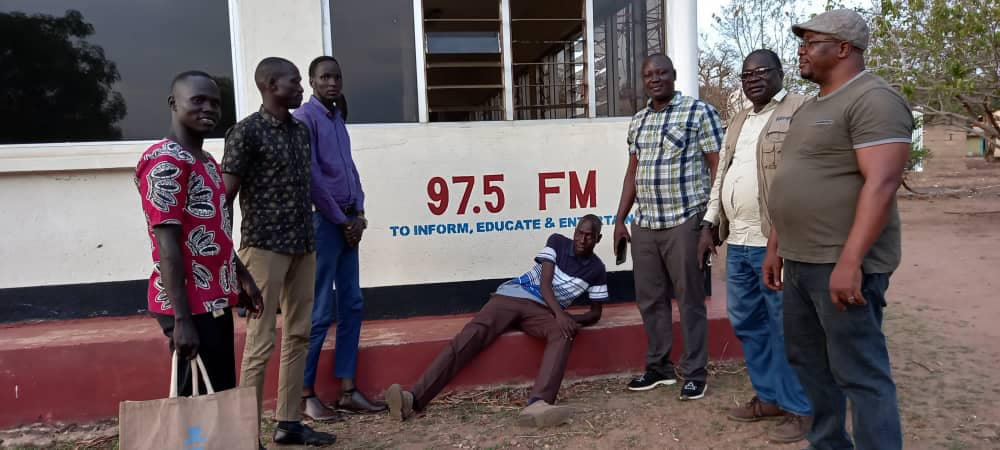
UJOSS Team in Torit, Eastern Equatoria State 2022
We have maintained constant communication with our regional offices, which has enabled us to monitor, track, and tackle media violations the moment they occur. Crucially, we have systematically improved our institutional relationship with key regulatory bodies and security actors, including the Media Authority, the Access to Information Commission, the National Security Service, the South Sudan People’s Defence Forces (SSPDF), and other organized forces.
Furthermore, we have strengthened our administrative ties with the Ministry of Information at both the national level and across all ten states, including the three administrative areas. By opening these direct channels for dialogue, we have been able to directly address rights violations and arbitrary arrests.
This continuous engagement yielded a historic milestone: in 2025, South Sudan led East Africa in the World Press Freedom Index for the very first time. In 2026, South Sudan dropped by nine positions from the spot it held in 2025.
The reasons for this decline in the World Press Freedom Index are numerous, including localized violence that occurred in parts of Jonglei State where some radio stations were forced to close, and recent regulatory actions taken against journalists in Unity State, among other regional challenges.
All in all, however, we are pleased to report that at the moment, there is no journalist in South Sudan who is in jail.
The aforementioned progress does not in any way mean that problems no longer exist in the country’s media industry.
We are still actively battling with the issue of censorship, administrative bottlenecks, and the extensive clearance requirements media practitioners still face when trying to travel for journalistic work across the country.
However, by formalizing our relationship with the government, particularly through the Ministry of Information at the national and state levels, the Media Authority, and the Access to Information Commission. We have built the leverage necessary to approach the relevant authorities the moment challenges arise. Engaging in this constructive dialogue rather than facing absolute silence is a major institutional achievement for UJOSS.
Land and Investment
To ensure the long-term financial independence and sustainability of the Union, we have focused on acquiring property so that UJOSS can eventually operate from its own facilities rather than relying on rented spaces. This strategic drive towards asset building has allowed us to secure a foothold in key regions:
- Jonglei State. We have successfully secured a plot in Bor.
- Eastern Equatoria State: We have successfully acquired land for investment in Torit to support regional operations and generate future institutional revenue.
- Lakes State: We initiated the land acquisition process in Rumbek. While the finalization has lagged behind due to recent administrative changes in state and local government leadership, we are actively pursuing its completion.
- Central Equatoria State: We are currently in the advanced process of acquiring prime land in the national capital, Juba, specifically to secure a permanent national headquarters for the Union’s future.
- Upper Nile State: We have successfully acquired two plots in Malakal, providing a consolidated space for future investment and infrastructure development.
Promoting Professionalism
We launched the first-ever Journalism Excellence Award, a signature initiative that has been running successfully for the past three years. This year will mark the highly anticipated fourth edition of the awards, through which we continue to recognize and reward journalists who deliver exceptional, impactful work across the country. To ensure the evaluation process remains highly professional and transparent, we have consistently engaged senior media professionals and respected industry veterans to serve on our independent panel of judges.
Building on this domestic success, we are now actively encouraging South Sudanese journalists to project their voices internationally by entering prestigious regional competitions, such as the IGAD Media Awards as well as continental contests where their reporting can gain global recognition.
Another major institutional milestone has been the deliberate strengthening of our international visibility and diplomatic positioning. UJOSS is an active, influential member of the Federation of African Journalists (FAJ) and the Federation of the Eastern Africa Journalists (FEAJ). Proving our growing regional clout, South Sudan currently holds the esteemed position of Vice President within the FEAJ executive leadership.
Furthermore, we have secured full membership status within the International Federation of Journalists (IFJ), complete with vital voting rights and the constitutional right to contest for any leadership position within the global body.
To keep our community, partners, and the public seamlessly informed of these advancements, we have also launched the official website for the Union of Journalists of South Sudan (UJOSS), which now serves as our primary, modernized channel for institutional communication and advocacy.
Challenges
Over the years, we have also faced serious institutional and industry-wide challenges. One of the most difficult issues to address remains the welfare of journalists.
Due to the ongoing economic crisis in the country, the government has been unable to pay its workers, including those employed in state-owned media houses, for several months.
Meanwhile, the commercial advertising market for private media remains incredibly small and is not growing at a sufficient pace. Consequently, low pay remains a persistent challenge that undermines the financial stability of journalism in South Sudan.
The rapid rise of new media and citizen journalism presents another complex challenge for our industry.
Today, individuals routinely use their smartphones to publish stories online that are often poorly researched, unverified, and unprofessional.
Unfortunately, the public frequently associates these amateur stories with professional journalists when they are not.
Clear-cut separation of citizen journalists from professional journalists, who take their work seriously, adhere to strict ethics, and earn their livelihood from the craft, is an ongoing struggle that presents a significant difficulty for our Union.
Finally, we face severe financial constraints. Driven by shifting global geopolitics and its subsequent contraction of international donor funding, we have struggled to hold regular General Assembly meetings.
Over the past five years, we have only managed to convene one General Assembly, which was generously funded by the Embassy of the People’s Republic of China in South Sudan, a vital support for which we are deeply grateful.
According to our constitution, holding an official UJOSS General Assembly requires the physical presence of representatives from at least seven out of the ten states, at least one administrative area, and journalists based in Juba.
The financial cost of flying representatives from a minimum of seven states and one administrative area to Juba, accommodating them, providing meals, and arranging their return transport is immense.
This heavy financial burden has severely impacted our ability to hold regular general meetings. Because of this, and looking determinedly toward the future, we have developed a comprehensive proposal on how the Union of Journalists of South Sudan should be structured and run moving forward.
Now and the Future
In order for the Union of Journalists of South Sudan (UJOSS) to sustain itself now and in the future, deliberate and strategic actions must be taken at this juncture. The primary vehicle for driving UJOSS toward financial independence will be the establishment of the Union of Journalists of South Sudan Savings and Credit Cooperative (UJOSS-SACCO).
- Governance and Management Structure
To ensure sound financial oversight and absolute operational efficiency, the management of the SACCO will be clearly and cleanly structured around two distinct bodies to guarantee accountability:
- The Management Team: A dedicated operations team must be set up completely separate from the UJOSS National Executive Committee (NEC). In the short term, this team will comprise professionals with specialized financial knowledge in fundraising, risk mitigation, and SACCO administration. Their immediate, primary mandate will be to drive member enrollment and actively encourage a culture of consistent saving among our journalists.
- The Board of Directors: The UJOSS National Executive Committee (NEC) will serve as the SACCO’s Board of Directors. In this capacity, the Board will provide vital regulatory oversight, offer strategic advisory opinions, and guide the management team through any institutional hurdles.
- Accountability and Transparency: To ensure complete operational transparency, the management team will be mandated to present a comprehensive annual financial performance report directly to the general membership at a mandatory annual general meeting.
2. Capital Investment and Public-Private Partnerships
Once a stable savings foundation is achieved, the SACCO management team will proactively pursue commercial opportunities and institutional contracts with non-governmental organizations (NGOs), international entities, and state governments.
A prime example of this model is infrastructure franchising. Under this framework, UJOSS-SACCO could secure a public utility contract, such as providing electricity in Torit, Eastern Equatoria State.
To execute this project, the SACCO would partner with an experienced technical service provider and secure project financing through a reputable commercial institution, such as the Cooperative Bank of South Sudan.
Under this structured arrangement, the financing bank would release development funds directly to the engineering firm to guarantee project delivery. Once the utility grid becomes fully operational, consumer utility payments would be systematically routed back through the financing bank to automatically service the loan.
After the amortization period is complete, the entire infrastructure facility would transition to being fully owned and operated by UJOSS-SACCO, creating a permanent stream of passive institutional revenue.
3. Asset Utilization and Real Estate Monetization
UJOSS will systematically transfer its existing fixed assets, including strategic parcels of land in Torit, Malakal, and Bor, directly under the custodianship of the UJOSS-SACCO.
The cooperative will then leverage this land portfolio to generate reliable streams of passive income.
Depending on the outcomes of comprehensive feasibility studies, the SACCO can secure joint-venture investors to develop commercial hotels, residential apartments, or modern office spaces.
Alternatively, the cooperative can simply lease the land out to corporate or institutional tenants to guarantee steady, long-term revenue streams that reinforce the Union’s financial independence.
4. Financial Empowerment and Professional Integrity
The core mechanism of the SACCO relies on disciplined personal finance, where members will make voluntary, customized monthly savings contributions.
After a minimum of six months of consistent saving, members become eligible to apply for low-interest credit lines.
To maximize accessibility, UJOSS-SACCO proposes an exceptionally low interest rate of 4% to 5% per annum, significantly lower than standard commercial bank rates.
The ultimate objective is to economically empower journalists to buy land, build homes, and launch parallel businesses.
This model systematically dismantles the harmful narrative that choosing a career in journalism requires bracing for a life of poverty.
While it remains ethically true that journalists must never accept money from sources or compromise their objectivity for financial gain, this professional boundary does not preclude them from legal entrepreneurship.
By leveraging a SACCO loan to build a rental property or launch an Airbnb, a journalist can generate legitimate wealth. This financial security allows professionals to comfortably afford comprehensive medical insurance and provide for their families without compromising their journalistic integrity.
5. Risk Management and Underwriting Standards
To protect the cooperative’s capital pool and ensure long-term stability, the management team will enforce rigorous loan underwriting standards.
Before approving any credit application, the committee will systematically evaluate the member’s financial capacity by reviewing:
- Employment Stability: The validity and duration of their active employment contract.
- Income Verification: Their verifiable net monthly income.
- Repayment Capacity: A realistic, debt-to-income-focused repayment schedule.
Furthermore, the committee will establish robust legal frameworks to handle defaults and mitigate financial risks in the event that a member’s employment contract terminates prematurely before their loan is fully amortized.
Path toward True Institutional Independence
By shifting toward this self-sustaining economic model, UJOSS will eventually decouple itself from its historic reliance on international donor funding.
In the long run, the Union will possess the internal liquidity required to independently fund nationwide journalist training workshops, bankroll its own annual general assemblies, and launch robust welfare programs entirely out of its own organic resources.
Agricultural Investment and Food Security
To directly address the critical issue of journalist welfare and create a resilient safety net against the high cost of living, UJOSS-SACCO will expand its investment horizon into commercial agriculture.
By venturing into farming, the Union aims to leverage South Sudan’s fertile land to achieve a dual purpose: supplying members with affordable, subsidized food commodities and generating substantial surplus revenue to fund welfare programs.
We will strategically target high-yield agricultural zones across the country, tailoring our production to the unique ecological strengths of each region:
- Renk (Upper Nile State): Utilizing this major agricultural hub for large-scale mechanized production of staple grains, such as sorghum and sesame, which hold high market value.
- Yambio (Western Equatoria State) & Yei (Central Equatoria State): Exploiting the rich, green belt potential of these areas to cultivate high-demand cash crops, fruits, and staple tubers like cassava.
- Torit (Eastern Equatoria State) & Mangalla (Central Equatoria State): Developing mechanized maize and vegetable farms, leveraging local irrigation potential to ensure steady year-round harvests.
- Aweil (Northern Bahr el Ghazal State): Investing in large-scale rice production and sorghum cultivation to tap into established regional markets.
The Welfare and Revenue Mechanism
This project operates on a structured, member-centric economic model:
- Subsidized Member Food Supply: A dedicated portion of every harvest will be funneled directly into a UJOSS food cooperative. Members will be able to purchase essential food items, such as flour, grain, and cooking oil, at heavily subsidized prices, significantly lowering their household expenses during tough economic times.
- Commercial Surplus Exploitation: The remaining surplus harvest will be packaged and sold directly into local commercial markets and supplied to humanitarian organizations operating in the region.
- Welfare Fund Injection: All net profits generated from these commercial agricultural sales will be directed into a dedicated UJOSS Welfare Fund. This fund will be utilized strictly to assist journalists facing financial distress, medical emergencies, or salary delays from their primary employers.
By merging agricultural entrepreneurship with institutional advocacy, UJOSS will transform local soil into a sustainable engine of financial security, ensuring that our members can thrive both professionally and personally.
The UJOSS Foundation
To build a sustainable future for our media landscape, we must also establish the Union of Journalists of South Sudan (UJOSS) Foundation.
This foundation will serve as an institutional home for retired members and former executive leaders of UJOSS. By bringing these seasoned veterans together, the foundation will tap into a wealth of institutional knowledge and industry experience to support several critical functions:
- Research Hub: Whenever UJOSS needs to conduct media research, it can directly commission experienced professionals from the foundation, ensuring they are fairly compensated for their expertise while keeping vital industry data accurate and locally driven.
- Mentorship and Training: These veteran members will lead training initiatives across the country. Having served in leadership roles and practiced journalism for decades, they are uniquely positioned to mentor and enhance professionalism among younger generations entering the field.
- Youth Outreach: The UJOSS Foundation will play an active role in community outreach by grooming students in primary and secondary schools. Foundation members will help establish and guide school journalism clubs, fostering a passion for the craft early on and keeping interest in our profession alive.
This visionary step is exactly what defines a union equipped for both today and the future.
UJOSS- BROADCASTERS’ DESK
Furthermore, we will establish a dedicated public and private broadcasters’ desk under the Union of Journalists of South Sudan (UJOSS).
This initiative aligns with our strategic shift toward managing media practitioners within specialized units.
Under this newly created desk, we will specifically address the unique issues that arise within the broadcasting sector, catering to both digital and online media platforms as well as traditional TV and radio networks.
This body will serve as an essential platform to handle industry-specific needs:
- Dispute Resolution and Mediation: In cases of copyright infringement, the desk will provide structured mediation to ensure intellectual property conflicts are resolved amicably. It will also look into professional challenges surrounding talent poaching and complex staff transitions between competing broadcasting houses.
- Elevating Sector Professionalism: It is well known that many radio and TV presenters are not formally trained journalists, having entered the field without attending journalism school. This specialized desk will create clear pathways to mentor these presenters, bringing them up to speed on media laws, ethical standards, and responsible reporting.
By anchoring this broadcasters’ desk directly within UJOSS, we can tackle these systemic challenges collectively and significantly elevate the standard of broadcasting across the country.
UJOSS PUBLISHERS’ DESK
Another vital entity that will be established is the publishers’ desk, which will operate as a dedicated desk under the Union of Journalists of South Sudan (UJOSS).
This desk will bring together media executives and professionals who produce print newspapers, manage digital publications, and run news websites.
It will serve as a central space to address critical challenges arising from modern publication practices.
This body will directly tackle structural, ethical, and technological issues within the publishing sector:
- Design and Commercial Balance: The desk will address practical standards such as newspaper layout and design, helping media houses find a healthy balance when front pages are overly flooded with advertisements at the expense of vital news coverage.
- Ethical Safeguards and Modern Tech: It will confront pressing contemporary challenges, including plagiarism and the integration of Artificial Intelligence (AI) in the newsroom, ensuring that new technologies are adopted without compromising strict journalistic ethics.
- Peer-Led Self-Regulation: By analyzing these issues under a specialized publishers’ desk, we can resolve many of our industry’s problems internally.
This structure will empower us to manage ourselves, self-regulate, and constructively advise one another, ensuring we have a unified body that resolves our disputes today while building a stronger, more resilient UJOSS for the future.
UJOSS-SPORTS DESK
The desk will include both journalists who report on sports and those who actively play them, such as football or volleyball.
We will establish a dedicated desk within the Union of Journalists of South Sudan (UJOSS) to support them, helping secure training equipment like balls and access to training grounds.
By creating this specific desk, we can streamline capacity building and ensure specialized support:
- Targeted Professional Development: When specialized training workshops are designed for sports journalists, we will know exactly who to target, rather than opening invitations to everyone. This structure will significantly improve our operations.
- International Event Coverage: When journalists are selected to travel abroad to cover international sporting events, we will have a clear, organized registry of members under this desk to identify the right professionals for the job.
Conclusion
A Vision of Continuity and Progress
We, the current UJOSS Executive, are deeply grateful for the opportunity and trust that the journalists of South Sudan have bestowed upon us to lead this vital institution for the past five years. It has been a profound honor to serve our media fraternity during a period of immense growth, resilience, and transformation.
As we look toward the horizon, we do so with fierce optimism for the future of our profession. Our tenure has been defined by turning systemic challenges into foundational milestones, laying a solid groundwork for an independent, professional, and prosperous union.
Summary of Achievements (Past Five Years)
Over the past five years, our collective dedication has elevated UJOSS to unprecedented heights across several key pillars:
- Institutional Growth & Asset Building
We successfully transitioned UJOSS from a renting organization toward long-term sustainability by acquiring strategic parcels of land for investment and future headquarters in Bor, Jonglei State, Torit, Eastern Equatoria state, Rumbek, Lakes State, Juba, Central Equatoria State, and Malakal, Upper Nile State etc…
- Promoting Professionalism & Global Standing
We successfully launched and sustained the Journalism Excellence Awards for three consecutive editions. Furthermore, we elevated South Sudan’s media profile internationally, securing full voting membership in the International Federation of Journalists (IFJ) and winning the Vice Presidency of the Federation of the Eastern Africa Journalists (FEAJ).
- Technological Modernization: We designed and launched the official UJOSS website, establishing a modernized, reliable primary communication and advocacy channel for all members.
- Strategic Vision for Welfare: In response to the persistent economic challenges facing our members, we have meticulously designed a revolutionary economic blueprint for the future. This includes the establishment of the UJOSS-SACCO, commercial agricultural investments for food security, the UJOSS Foundation for veteran mentorship, and specialized desks for Broadcasters, Publishers, and Sports Journalists.
Securing the Future Together
An institution is only as strong as its continuity. The ambitious, self-sustaining frameworks we have laid out, shifting UJOSS away from donor dependency and toward true financial independence, require experienced, steady hands to transition from blueprint to reality.
Together, let us safeguard the gains of the past five years and build a sustainable, dignified, and fearless UJOSS for generations of journalists to come.
Forward together, for media excellence and independence.