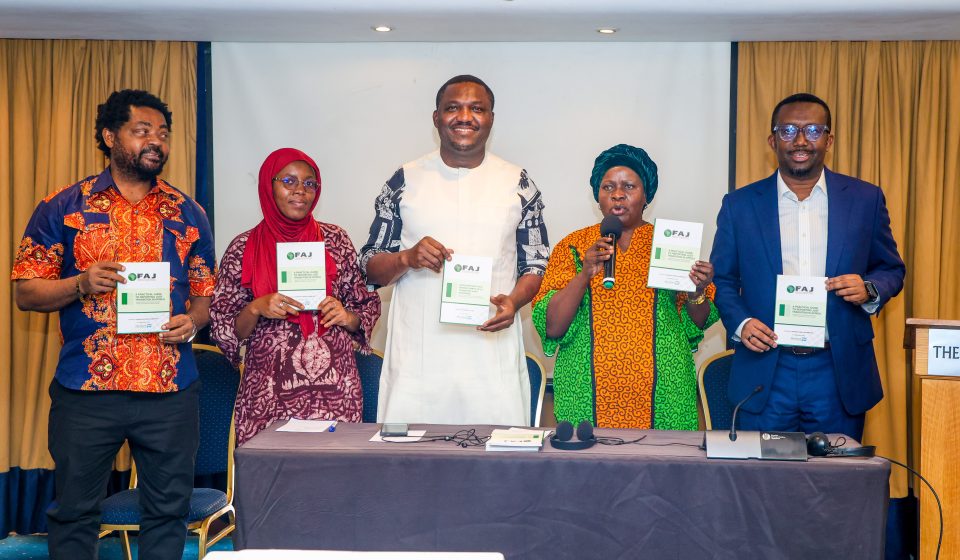

The Federation of African Journalists (FAJ) has unveiled A Practical Guide to Reporting Just Transition in Africa, Africa’s first continental guide dedicated to strengthening reporting on the just transition by equipping African journalists and newsrooms with practical knowledge and reporting tools to cover climate change, workers’ rights, climate justice, climate finance, renewable energy and sustainable development from an African perspective.
The guide was unveiled during the just-concluded conference on African Workers’ Contribution to Energy Sovereignty, Green Industrialisation and a Common African Position for COP31 in Nairobi, Kenya. The conference brought together trade union leaders, representatives of civil society organisations, journalist leaders and members of the African Group of Negotiators on Climate Change (AGN). Discussions focused on Africa’s approach to energy sovereignty, green industrialisation and the just transition, with particular attention given to the role of the media in strengthening public understanding and informed debate.
The guide was unveiled by FAJ President Omar Faruk Osman alongside ITUC-Africa General Secretary Akhator Joel Odigie, ITUC-Africa Deputy President Rose Omamo, Chair of the FAJ Working Group on Climate Change Ahmed Sahid Nasralla and President of the Gambia Press Union (GPU) Isatou Keita, reflecting a shared commitment by journalists’ organisations and the African trade union movement to improve reporting on the just transition as one of Africa’s most important public interest issues.
“Just transition is one of the most important public interest journalism issues of our time because it profoundly affects people’s jobs, livelihoods, workers’ rights and the future of our economies. Africa and its people are among those hardest hit by a climate crisis they did not create, making a just transition an important pathway towards a fairer and more sustainable future. Journalists are at the heart of that journey, helping people understand the opportunities, challenges and choices that come with the transition. This guide equips them with the knowledge and practical tools to report these issues accurately, fairly and responsibly, strengthening journalism that informs the public, gives voice to workers and communities and ensures that African perspectives help shape decisions on the continent and contribute to the global conversation on climate change,” Osman said.
Developed by African journalists with contributions from experts in climate policy, labour and media, the guide offers practical reporting techniques, case studies and ethical guidance on covering climate justice, climate finance, renewable energy, workers’ rights, information integrity and other issues central to Africa’s just transition. It builds on FAJ’s sustained engagement on climate reporting and responds to increasing demand from journalists for practical resources tailored to African realities.
Chair of the FAJ Working Group on Climate Change Ahmed Sahid Nasralla said the publication was shaped by lessons from FAJ’s engagement with journalists and trade unions across the continent. “From Côte d’Ivoire to Kenya and Ethiopia, we have seen growing interest among journalists in reporting on the just transition, but we have also recognised the need for practical guidance. Climate change is one of the most complex and high-stakes stories of our time, yet many journalists continue to face challenges in accessing specialised knowledge and reliable reporting tools. This guide is designed to help bridge that gap by supporting accurate, ethical and evidence-based reporting that reflects African realities, voices and solutions.”
Published in English, French and Portuguese, the guide will be distributed through FAJ’s affiliated journalists’ unions and media organisations across Africa, with digital editions made freely available to maximise access. Its production was funded by Mondiaal FNV, the international solidarity organisation of the Dutch trade union movement (FNV), in support of strengthening trade union engagement on climate justice, decent work and the just transition.
Welcoming the publication, ITUC-Africa General Secretary Akhator Joel Odigie said stronger collaboration between journalists and trade unions would help ensure workers’ concerns receive greater public awareness and influence policy discussions. “Trade unions are doing remarkable work, but too often their stories go untold. FAJ has produced an important guide that will help journalists better understand the just transition and the concerns of workers, ensuring that these issues become part of the public conversation and inform policy decisions. Better media coverage will strengthen public understanding, encourage governments to adopt policies that protect workers and affected communities and contribute to a fairer transition. We should also begin recognising outstanding journalism across Africa on the just transition because quality reporting deserves recognition”, Odigie said.
“Workers including journalists are asking what the transition means for their future. This guide will help journalists explain those changes while also helping trade unions communicate more effectively with their members. We must ensure that workers have opportunities to reskill and upskill and that no one is left behind. Most importantly, this guide should be used, shared and discussed because informed journalism can help people understand both the opportunities and the challenges of the transition,” said ITUC-Africa Deputy President Rose Omamo.
Speaking on behalf of FAJ’s affiliated journalist unions, GPU President Isatou Keita said the publication would become an important professional development resource for journalists’ unions across the continent. “This guide gives our national journalists’ unions a practical resource that they can immediately use to support working journalists. Across Africa, journalists are increasingly reporting on climate change and its impact on people’s lives, but many need accessible guidance to cover these complex issues with confidence and accuracy. Our unions will use this publication in training, mentoring and professional development so that member journalists are better equipped to report on the just transition in ways that are relevant to their audiences and responsive to the realities of their countries.”
The guide forms part of FAJ’s broader programme to strengthen public interest journalism on climate change, the just transition and information integrity across Africa. Working closely with ITUC-Africa, Global Union Federations in Africa, its affiliated journalists’ unions, news media organisations and development partners, FAJ aims to strengthen journalists’ capacity to report accurately on the economic, social and environmental dimensions of climate change while ensuring that African voices and perspectives remain central to national, continental and global policy discussions.